Turbine Flow Meteroperating principle
The turbine flow meter is a volume measuring turbine type. The flowing fluid engages the rotor, causing it to rotate at an angular velocity proportional to the fluid flow rate.
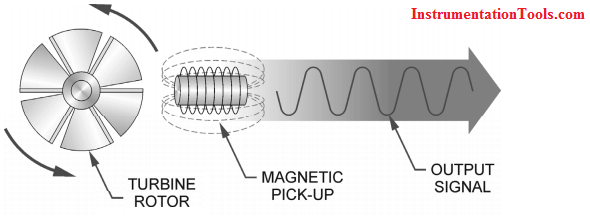
The angular velocity of the rotor causes an electrical signal (AC sine wave type) to be produced in the pickup. The sum of the pulse electrical signals is directly related to the total flow rate.
The frequency of the signal is directly related to the flow rate. The vane rotor is the only moving part of the flow meter.
Turbine flow meter (axial flow turbine)Invented by Reinhard Woltman, it is an accurate and reliable liquid and gas flow meter. It consists of a flow tube with end connections and a magnetic multi-blade free-spinning rotor (impeller) mounted inside; it follows the flow of the flow. The rotor is supported by a shaft on an internally mounted bracket.
Process Support The automatic turbine flow meter design also acts as a rectifier, stabilizing the flow and minimizing the negative effects of turbulence. The bracket is also equipped with unique open bearings; allowing the measured medium to lubricate the bushing - extending the life of the flow meter. The bracket is fixed by locking rings (retaining rings) at both ends.
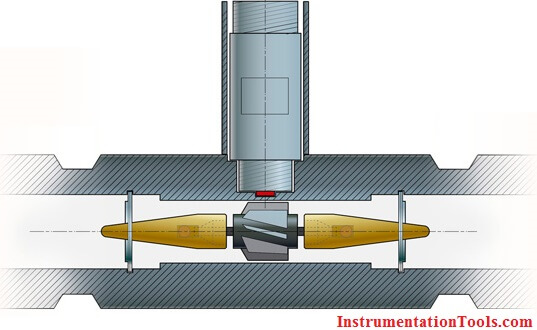
The rotor is mounted on a shaft, which is suspended in the flow by two brackets. As the medium flows, a force is exerted on the rotor wings. The angle and shape of the wing convert horizontal forces into vertical forces, creating rotation. Therefore, the rotation of the rotor is proportional to the applied flow force.
Therefore, as soon as the medium generates forward force, the rotor will rotate immediately. Since the rotor cannot move through the media on its own, it will stop as soon as the media stops. This ensures extremely fast response times, making the turbine flow meter ideal for batch applications.
The pick-up sensor is mounted above the rotor. As the magnetic blade passes the pick-up sensor, a signal is generated for each passing blade. This provides a pulse signal proportional to the rotor speed and represents pulses per volume unit. So, too, does the flow rate.
Also Read: Flow Meter Troubleshooting Tips
Advantages and Disadvantages
The cost is moderate.
Very good at cleaning,
Low viscosity fluids at moderate and steady rates.
The regulation is very good as it reads very low compared to the maximum flow rate.
If put into clean liquid, they are reliable, especially if it has some lubricity.
AGA and API approved for custody transfer.
They do cause some pressure drop, possibly due to factors such as gravity flow.
Steam is unreliable
Bearing wear.
Applications
In order of magnitude from large to small,
These are used in oil and gas,
Water and wastewater,
Gas utility,
Chemistry,
Electricity, food and drink,
Aerospace, pharmaceuticals,
Metals and Mining, Pulp and Paper.
turbine flow meter Precautions
Turbine flow meter are less accurate at low flow rates due to rotor/bearing resistance slowing the rotor speed. Be sure to operate these flow meters above approximately 5% of maximum flow. Turbine meters should not be operated at high speeds as premature bearing wear and/or damage may occur.
Be careful when measuring non-lubricating fluids as bearing wear can cause the flow meter to become inaccurate and malfunction. In some applications, periodic bearing replacement may be required and increased maintenance costs.
Applications in dirty fluids should generally be avoided to reduce the possibility of flow meter wear and bearing damage. In summary, turbine flow meter have moving parts that degrade over time and use.
Abrupt transitions from gas to liquid flow should be avoided as they can cause mechanical stress to the flow meter, reduce accuracy, and/or damage the flow meter. These situations typically occur when filling pipes and during slug flow conditions. Two-phase flow conditions can also cause turbine flow meter measurements to be inaccurate.
Wide flow range, including low flow rates
Turndown ratio up to 35:1
Get good accuracy at an economical price
Simple, durable construction
Easy to install and maintain
Flexible connection of flow meters for flow control
Various process connections
Turbine flow meters can operate over a wide range of temperatures and pressures
Low pressure drop across turbine
Provides convenient signal output
Turbine flow meter limitations
Constant back pressure is required to prevent cavitation
Air bubbles in liquid adversely affect accuracy
Turbine flow meter should only be used with clean liquids and gases (a filter may be required upstream to prevent particulate matter damage)
Not suitable for measuring corrosive fluids
A turbulent flow profile (consistent fluid velocity across the pipe diameter) is required to ensure accuracy
Sensitive to changes in fluid viscosity
A straight pipe is required before and after the turbine flow meter to allow Vortex patterns in the flow to dissipate
May not work properly for highly viscous fluids with laminar flow profiles





 Home


