1. What is a magnetostrictive linear displacement sensor?
Magnetostrictive Position Sensor is a displacement detection device with special advantages developed based on the magnetostrictive effect of ferromagnetic materials. It has special advantages such as high reliability, high resolution, non-contact measurement, oil resistance and anti-fouling. It can continuously, accurately and real-time detect the displacement (position) and speed of various moving parts in harsh industrial environments. It is an important component to achieve precise operation and control, and can greatly improve the accuracy and efficiency of the entire system. It is suitable for stroke or position detection of any mechanical device with linear motion trajectory. Precision servo feedback control of hydraulic system is one of its typical applications.
2. Working principle of magnetostrictive displacement sensor
The detection principle of the magnetostrictive linear displacement sensor is based on a magneto-elastic coupling effect between the core detection element of the sensor - the magnetostrictive waveguide element and the vernier magnetic ring, which is the so-called Wiedemann effect.
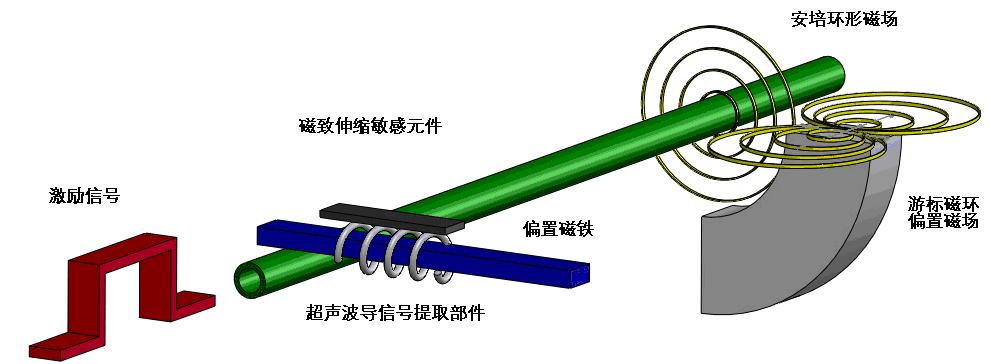
During measurement, the excitation module in the electronic cabin applies a current pulse to both ends of the magnetostrictive waveguide material. This pulse forms a circumferential ampere ring pulse magnetic field around the waveguide wire at the speed of light. When this ring magnetic field is coupled with the bias permanent magnetic field of the vernier magnetic ring, a Weidmann effect torsional stress wave will be formed on the surface of the waveguide wire. The torsional wave propagates in the waveguide material at its intrinsic speed (about 2800m/s) from the generation point to the waveguide wire. The torsional wave propagates at both ends, the torsional wave transmitted to the end is absorbed by the damping device, and the signal transmitted to the excitation end is received by the detection device. The control module in the electronic cabin calculates the time difference between the query pulse and the received signal, and then multiplies it by its intrinsic speed to calculate the distance between the location where the torsional wave occurs and the measurement reference point, that is, the absolute distance between the vernier magnetic ring at that instant relative to the measurement reference point, thereby achieving real-time accurate measurement of the position of the vernier magnetic ring.
3. What issues must be paid attention to when selecting a displacement sensor?
(1) Working mode: built-in or external;
(2) What is the effective range of the sensor;
(3) Output mode: analog 4~20mA current, 0~10V voltage, SSI output resolution and encoding method, etc.
(4) Product workplace and environmental requirements
(5) Connection method: straight cable or aviation plug
4. How long is the ordering cycle for sensors? Is there expedited service?
Standard model delivery time is within 4 weeks. Expedited service can be provided, but an additional expedited fee (charged based on the number of sensors) is required as the labor fee required for overtime work. Please consult our sales staff for details.
6. How long can the sensor range be produced?
Depending on the specific order model, the normal measuring range of RH series products is 50-3500mm. If it exceeds the normal measuring range, technical support must be consulted.
7. When ordering a sensor, should the first and end measurement dead zones be added to the order length?
No, you only need to provide the effective stroke when ordering, that is, the actual stroke of the cylinder or mechanical action. In fact, the zero zone and dead zone are both fixed lengths, so the distance between the two ends will be automatically added when ordering. If necessary, the dead zone can be lengthened or shortened according to the actual needs of the customer (please pay attention to the instructions when ordering).
8. Can the measuring range be changed after the sensor leaves the factory?
Yes, the sensitive element of the magnetostrictive displacement sensor is customized and produced according to the effective range.
If the actual required measuring range is less than the ordered length, the user can sacrifice part of the stroke (the sensor must be installed with a built-in oil cylinder, and the piston rod must be of sufficient length).
If the actual required range is greater than the order length, there is no solution.
9. Does the sensor have input voltage protection function?
The sensor is equipped with overvoltage protection (≤36VDC) and power supply direction reverse polarity protection (≤- 30VDC). However, the reverse polarity access time should not be too long (30 minutes), otherwise it may be burned out.
Note: If the 220V AC power supply is connected incorrectly, causing the electronic module to fail, it will not be covered by the product warranty!





 Home


