This article introduces the structure and working principle of a flow meter that directly measures fluid mass flow from a liquid mass flow meter sensor. This paper is a good example of how a careful step-by-step study of the underlying theory can lead to a description that could otherwise be extremely mathematical and incomprehensible. (Eds.) Described below is a unique mass flow meter that monitors the motion of each molecule of flowing material and sums all flow forces to produce a total force that is an accurate, linear measurement of mass flow. The instrument can be used to measure the flow of gases, liquids or heterogeneous materials and uses photoelectric technology to sense force.
Introduction to Coriolis Principle
To measure the rate of mass through a pipe, you must first fully understand how to measure the mass itself. Newton's second law (F=Ma) provides a way to measure mass, which states that when an unbalanced force system acts on an object, it produces an acceleration in the direction of the unbalanced force that is inversely proportional to the object's mass. The important concept is that mass cannot be measured without applying a force to the system and then measuring the resulting acceleration.
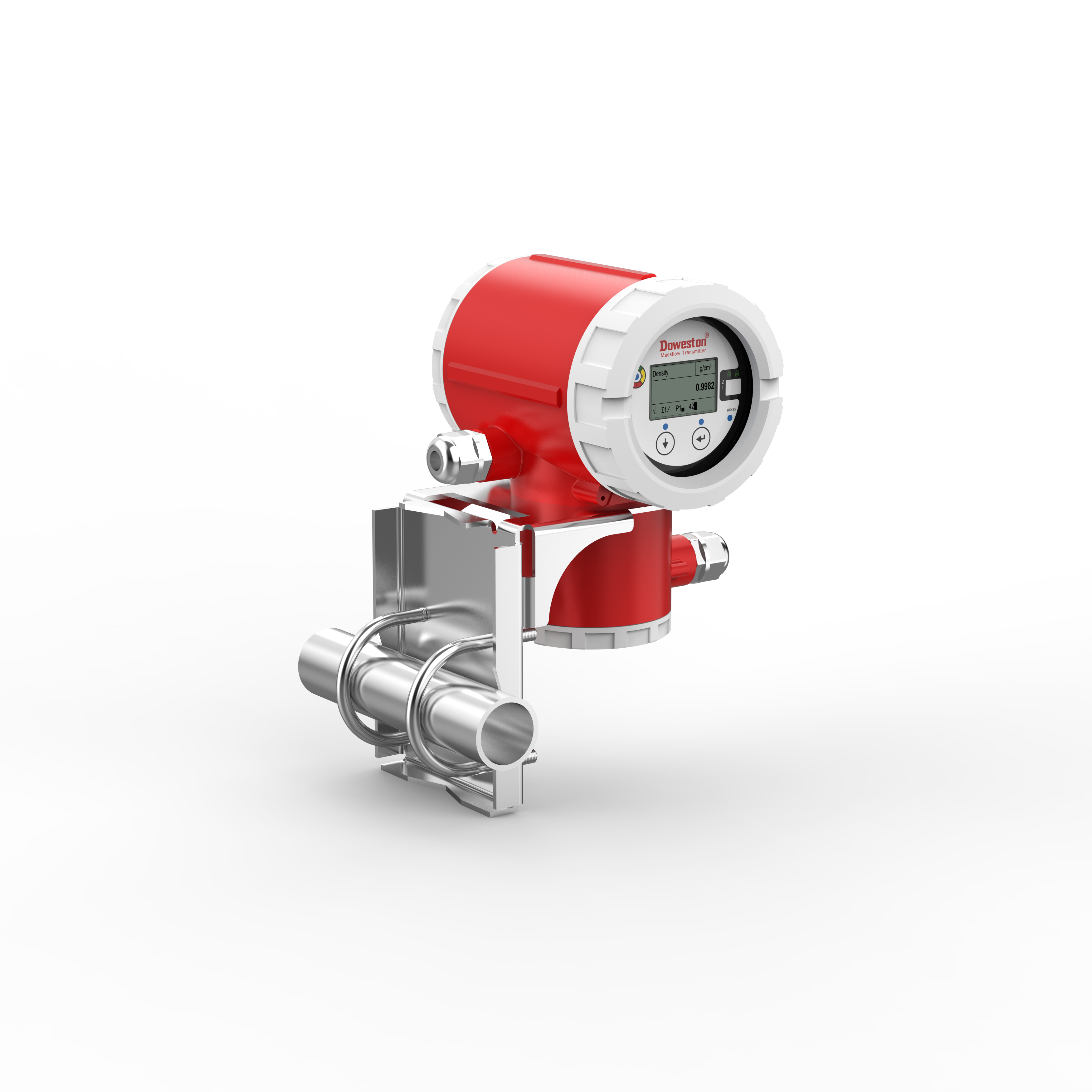
Editor's Note Measures the acceleration of a fluid due to a given force. Therefore, most flow meters on the market today measure a quantity that includes mass rather than directly measuring mass. An example of an inferred mass flow meter is a thermaltype flow meter, which measures implied mass flow under certain constraints (such as constant specific heat). Another way to extrapolate is to use a positive displacement flow meter with appropriate corrections for temperature, specific gravity, and pressure. Mass flow rate is based on calculations using several methods:
It is necessary to measure mass flow directly, and equipment has been developed to accomplish this difficult task. Angular momentum mass flow meters include an impeller that applies a Vortex to the flowing fluid and a method of measuring the torque required to eliminate the resulting Vortex. The measurement concepts of the Coriolis force and gyroscopic precession were studied and developed over many years. The main problem with this type of flow meter is the difficulty in measuring extremely small forces. This article introduces a mass flow meter that successfully uses the gyro-Coriolis principle to directly measure mass flow. This paper also describes the development of a new and simple method, applying optoelectronic technology, to make these concepts practical.





 Home


