The problem of using CMF to measure wet gas has been discussed in previous articles. For details, see the quote."Application of Coriolis Mass Flow Meter in Wet Gas Measurement"
In response to the above difficulties, we propose a three-step procedure for using a CMF Coriolis mass flow meter as a WGM.
The first step is to establish a CMF model in wet gas flow measurement. The traditional CMF model is not applicable because the compressibility of the gas phase will cause different vibrations between the gas, liquid and flow tube walls. Different flow patterns, such as stratified flow, annular flow and fog flow, must have different CMF metrology models.
The second step is to establish a model-based control method to keep the vibration parameters in the tube stable, stable, and rapid as the gas-liquid two-phase flow changes.
The final step is to develop model-based signal processing algorithms to obtain accurate gas and liquid flow readings. Specific implementation details are given in the next section.
Experimental study on Coriolis mass flow meter
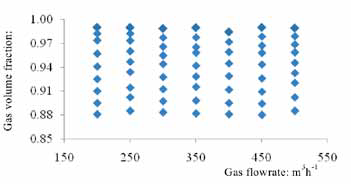
Experiments were carried out on the two-phase flow experimental bench [4] at Cranfield University, UK. The test matrix is shown in Figure 1. The two selected CMFs are installed on the drilling rig in sequence, one vertically and the other horizontally. The diameter of the experimental pipe and CMF is 2 inches. The experimental fluids are air-water and air-oil. Gas flow rate is 200~500sm3h-1, liquid flow rate is 0.11~1.5Kgs-1, and pressure is 100~300KPa. The calculated GVF under metering conditions is 88% to 99%, which is within the wet gas flow range. For the sake of brevity in the following paragraphs, we will refer to the vertical Coriolis meter as CMF01 and the horizontal Coriolis meter as CMF02. In addition to comparing the effects of the two installation methods, the results mainly focus on CMF02. The data collected include the amplitude and frequency of flow tube vibration, total mass flow rate, excitation current, damping coefficient, fluid temperature, flow tube temperature and DP signal through the CMF.
Through the analysis of experimental data, the following five results were obtained: Finding 1-The measurement repeatability is acceptable. CMF as WGM has better measurement repeatability, but the error is larger. The frequency reading repeatability test results are shown in Table 1. Repeatability error is defined as the relative error of frequency output. The frequency output range is 465Hz~562Hz. The upper and lower limits are the CMF frequency of gas-liquid two-phase flow measurement. Repeatability tests are conducted over a period of time but with nearly the same gas and liquid flow rates and the same pressure and temperature.
The two instantaneous frequency outputs are represented in Table 1 as frequency 1 and frequency 2.The wet gas flow rates selected in Table 1 have almost the same GVF under metering conditions and therefore the flow tubes have almost the same oscillation frequency. The maximum repeatability error is less than 0.5%, and mostly less than 0.2%. In the natural gas industry, using CMF as a WGM is an excellent method that has potential advantages over other types of flow meters and density meters.
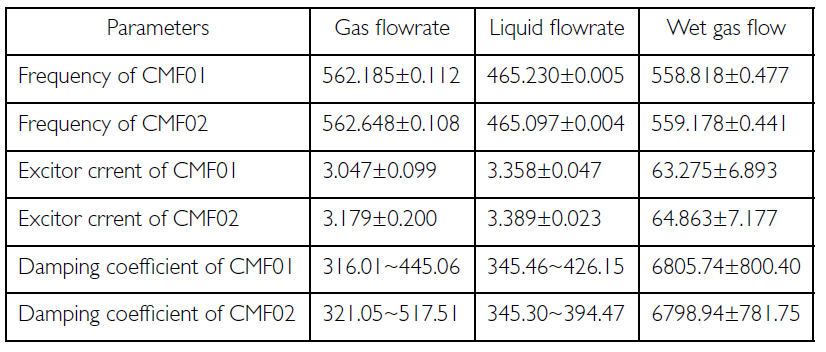
Table 2 shows the mean and standard deviation of frequency, exciter current and damping coefficient for three different metering conditions, namely gas metering only, liquid metering only and wet gas metering. In Table 2, the gas flow rate is 150sm3h-1∼700 sm3h-1, the pressure is 300KPa, the temperature is 12°C, and the liquid flow rate is 0.2kgs-1∼7.1kgs-1. The wet air flow consists of 350sm3h-1 airflow and 0.45kgs-1 water flow, and the calculated GVF is 97.7%.
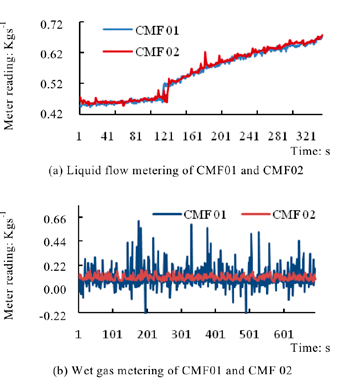
Differential pressure readings caused by pipe gravity and throttling are difficult to separate, but gravity has no effect on differential pressure measurements in horizontal installations. Figure 2 shows two sets of mass flow signals of CMF01 and CMF02 for liquid flow and wet gas flow measurements. Liquid flow rate is 0.45Kgs-1~0.70kgs-1. The wet gas flow consists of 200sm3h-1 gas flow and 0.116Kgs-1 water flow. The conclusion drawn from Figure 2a is that in single-phase flow measurement, there is almost no difference between the two CMF outputs shown in Figure 2a. Since CMF01 is installed in front of CMF02, when the fluid flows through CMF01 and CMF02 at different times, there is a delay between the output signals of the two instruments. Figure 2 shows that there are random changes in the output signal of CMF01, with some of its mass flow readings being negative, but these random changes do not occur in CMF02. We concluded that horizontal installation is more suitable for moisture metering. Further experiments showed that when the gas flow rate increased to above 250sm3h-1 (liquid flow rate remained at 0.226Kgs-1), the readings of CMF01 were all positive, but the output change of CMF01 was still greater than that of CMF02. Theoretical analysis and experimental data also show that when the gas flow rate is less than 250sm3h-1 and the liquid flow rate is greater than 0.11Kgs-1, CMF01 will have a counterflow, that is, a vertical pipe, which is the reason for the negative output of CMF01. Discovery 4 - The fourth is wet gas density measurement flow. Figure 3 shows the density reading of CMF02 and the actual density calculated by the gas and liquid flow rates from the reference meter in the experimental bench. If the gas flow rate is held constant, the relationship between the actual density and the CMF02's density reading is approximately linear. That is, when the gas flow rate is known, the Coriolis flow meter can accurately track changes in liquid composition. Result 5 - The total mass flow measurement of wet gas flow is accurate. Figure 4 illustrates the approximately linear relationship between CMF01 mass flow readings and actual mass flow. The coefficient of determination for Figure 4 is 0.9957. Explains the correctness and accuracy of moisture flow CMF readings.
Conclusion
There are many advantages to using CMF as a WGM. Most importantly, the relationship between true mass flow and CMF readings is almost linear. When the gas flow is kept constant, the CMF can linearly track changes in liquid flow. For the wide application of CMF as a WGM in the gas industry, horizontal installation is recommended. When the gas flow rate is large enough and the liquid flow rate is low, there is no difference in how CMF is installed as a WGM. It is pointed out that CMF has the characteristics of good repeatability, high accuracy and linear relationship, and is an ideal WGM for gas flow measurement in the natural gas industry.





 Home


