Let's explore the "Time Science of Flight" together
The demand for accurate and reliable sensors is growing in many markets around the world, such as industrial and manufacturing, automotive, medical, energy and smart grid applications. Designers and users of these sensors are counting on new technologies with lower power consumption and higher accuracy that will eliminate moving parts and allow sensing measurements to be made in remote locations and under optimistically ideal conditions. One area where sensor technology is effective is in ultrasound, the science of measuring the time interval between emitted and received ultrasonic signals, or what is commonly known as "time of flight" (TOF). Doweston leverages its ultrasonic expertise to deliver new signal conditioning solutions for new products for level sensing, fluid identification, flow metering and distance sensing customers
(LUT-20 Series Ultrasonic Level Gauge and LUT-10 Series Ultrasonic Level Gauge) based on time-to-digital converter (TDCS).
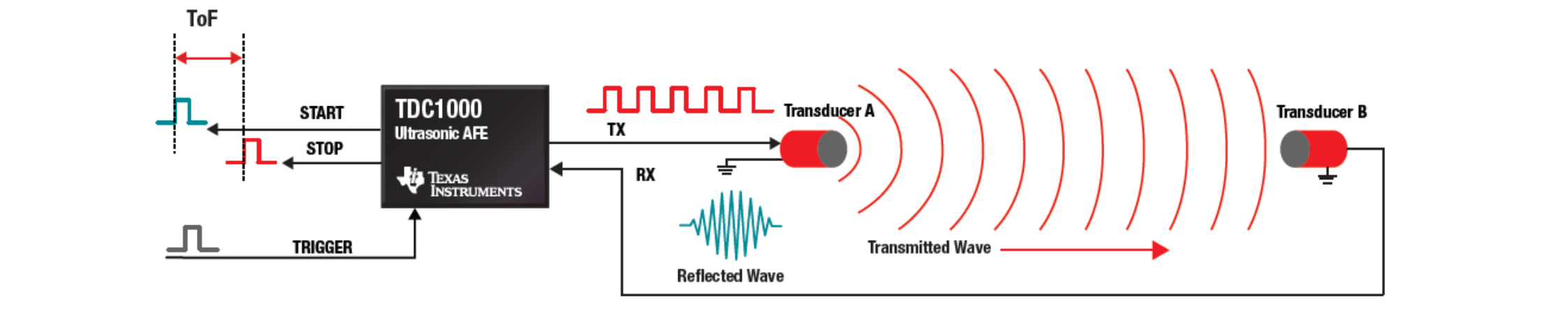
As a general theory of how ultrasonic sensing works for a single sensor in level, fluid identification, and distance applications, the LUT Series Ultrasonic Level Gauge excites the sensor and detects the echo on its return, as shown in Figure 1. The sensor is excited by hitting it with a series of pulses and frequencies in the kHz to MHz range. The meter allows 31 pulses to excite the sensor with a frequency range of 31.25 kHz to 4 MHz. The excitation of the sensor is marked by a start pulse, while the echo is represented by a stop pulse. The time difference between start time and time of flight (TOF) represents liquid level, fluidization/concentration, and distance.

For dual-sensor applications, such as flow meters (Figure 2), the LUT Series ultrasonic level meters use sensors in both pitch and snap modes. In this method, sensor A is excited by the TDC1000, while sensor B acts as a receiver to generate the stop pulse. The time of flight between the excitation pulse and the stop pulse (TOFAB) represents the distance between the sensors. Differential ToF, TOFAB–TOFBA, requires finding the flow of a medium (water or gas) between two sensors.
More information on how ultrasound can be used in level sensing, fluid identification, flow metering, and distance sensing applications is discussed in the next section.
LUT-10 Ultrasonic Analog Front End and LUT-20: The Time-to-Digital Converter LUT-20 (Figure 3) is an analog front-end IC that drives ultrasonic sensors in sensing applications. As the first ultrasonic sensor from TI, the LUT-20 offers a number of key features and benefits, including very low sleep power and programmable modes, enabling the lowest power solutions and improving battery life in flow meter applications. Along with a companion device, TI's TDC7200 time-to-digital converter (Figure 4), this solution provides a high level of accuracy for zero and low flow rates in the picosecond range.
Application Notes
applications 1: level measurement
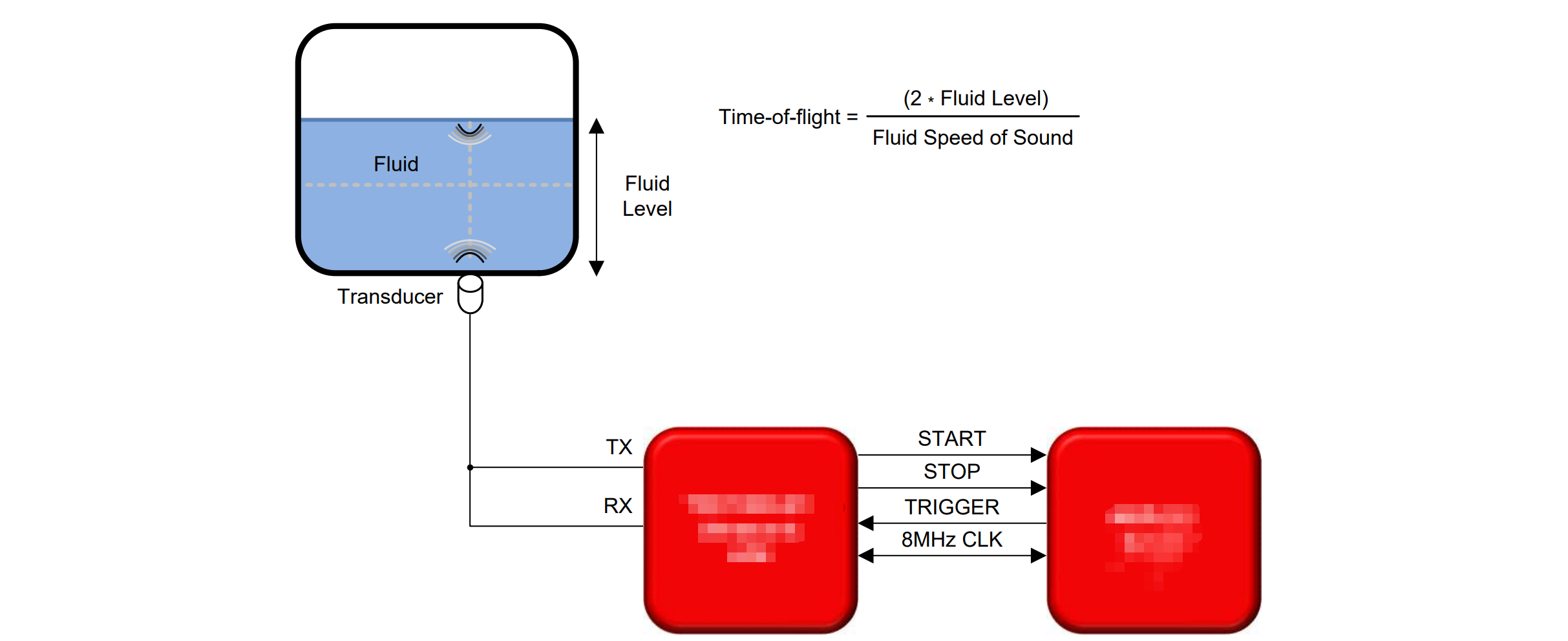
The TDC1000 is ideal for many sensing applications, some of the most common involving fluid management. Figure 5 shows a schematic diagram of detecting liquid level in a container. Ultrasonic sensors are installed at the bottom or top of the reservoir to determine the fluid level. The TDC1000 ultrasonic AFE excites non-invasive sensors with 1 to 31 pulses. The sensor continuously transmits high-frequency pulses (typically 1 MHz) into the fluid. The TDC1000 then reports the time of flight (TOF) of the wave traveling to the liquid surface and reflected back to the sensor. Referring to the speed of sound in the fluid, and using the equation TOF = (2*liquid level)/(speed of sound), the exact distance between the liquid surface and the sensor can be calculated with high accuracy. For example, assuming the sensor is mounted at the bottom of a tank, the TDC1000 reports a TOF of 1 m s.
Knowing that the speed of sound through water at 25°C is approximately 1480 m/s, the liquid level can be calculated as:
TOF=(2*liquid level)/(speed of sound)(1)
Liquid level = (TOF*Sound speed)/2 (2)
level = (1 m s*1480 m/s) /2 (3)
level =0.74m
Application 2: Fluid Measurement
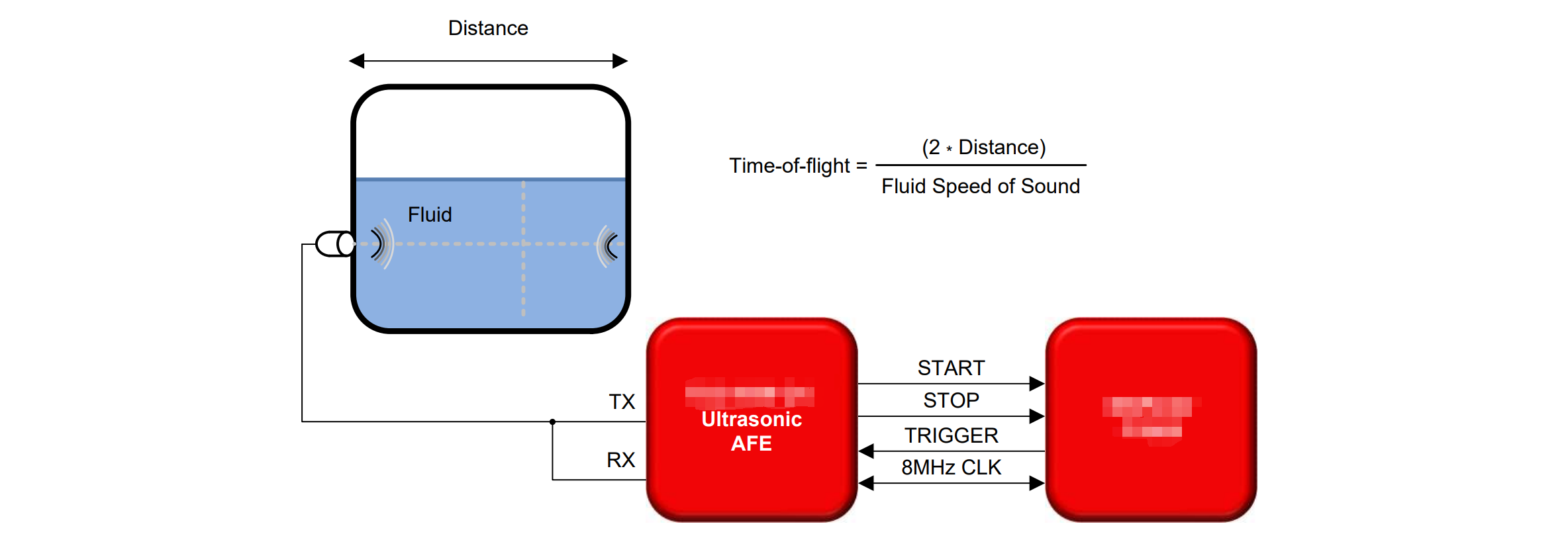
Fluid Identification/Concentration Now let's add to this level of application and see how Fluid Identification (ID) works. Fluid ID is the same as liquid level detection, except that the sensor is usually mounted on the side of the tank, as shown in Figure 6. The TDC1000 excites the sensor again and then reports the time it takes for the wave to travel and reflect. Since the exact distance is known and the time of flight (TOF) is measured, the speed of sound through the fluid can be calculated and checked against a lookup table to identify the fluid. For example, assuming the tank is 0.1m away, the LUT-20 ultrasonic will report a TOF of 134 microseconds and we can calculate the speed of sound as:
TOF=(2*distance)/(speed of sound)(5)
Speed of sound = (2*distance)/(TOF) (6)
Speed of sound = (2*0.1 m)/(134 microseconds) (7)
Speed of sound = 1490 m/s (8)
Using a lookup table and knowing that the temperature is approximately 25°C, we can find out that the unknown liquid in the tank is oil.





 Home


