In many applications, these processes are based on precise measurement of the fluid flow associated with the process. Examples include petroleum, water/wastewater supply and management, nuclear power generation and hydropower.
In these applications, accurate and precise flow measurement is necessary, otherwise serious performance-related problems may arise. Potential problems include loss of profits, system damage, or potential danger to the public.
There are manyflow meterCan accurately measure flow, but none of theflow meterCan be adapted to any situation requiring flow measurement or to suit every budget.
In this case, it is necessary to determine which flow meter is best for each application. The flow meter used in this study were supplied by Main Flow Signaling, Doweston, Siemens and Munters.
There are seven types of flow meters: three different types of Venturi meters (Classic Venturi, Halmi and HBX Venturi), single wedge flow meter, single V-cone flow meter, single ultrasonic flow meter and electromagnetic flow meter.
Each scale is evaluated and then assigned to the situation that best fits that scale. The flow meter tested included three different metering technologies, namely ultrasonic, electromagnetic and differential pressure. The ultrasonic instrument was provided by Fujifilm Corporation. The function of an ultrasonic flow meter is to send ultrasonic pulses from the upstream sensor of the flow meter to the downstream sensor. The time difference between pulse 2 at the sensor is caused by the flow rate, so the flow rate can be calculated (Fuji Electric Co., 2013). The electromagnetic flow meter is provided by Doweston Company.
Electromagnetic flow meters are "based on Faraday's law of electromagnetic induction, according to which a sensor converts flow into a voltage proportional to the flow rate." The coefficient (C) used by electromagnetic flow meter and ultrasonic flow meter is the ratio of indicated flow rate to actual flow rate.
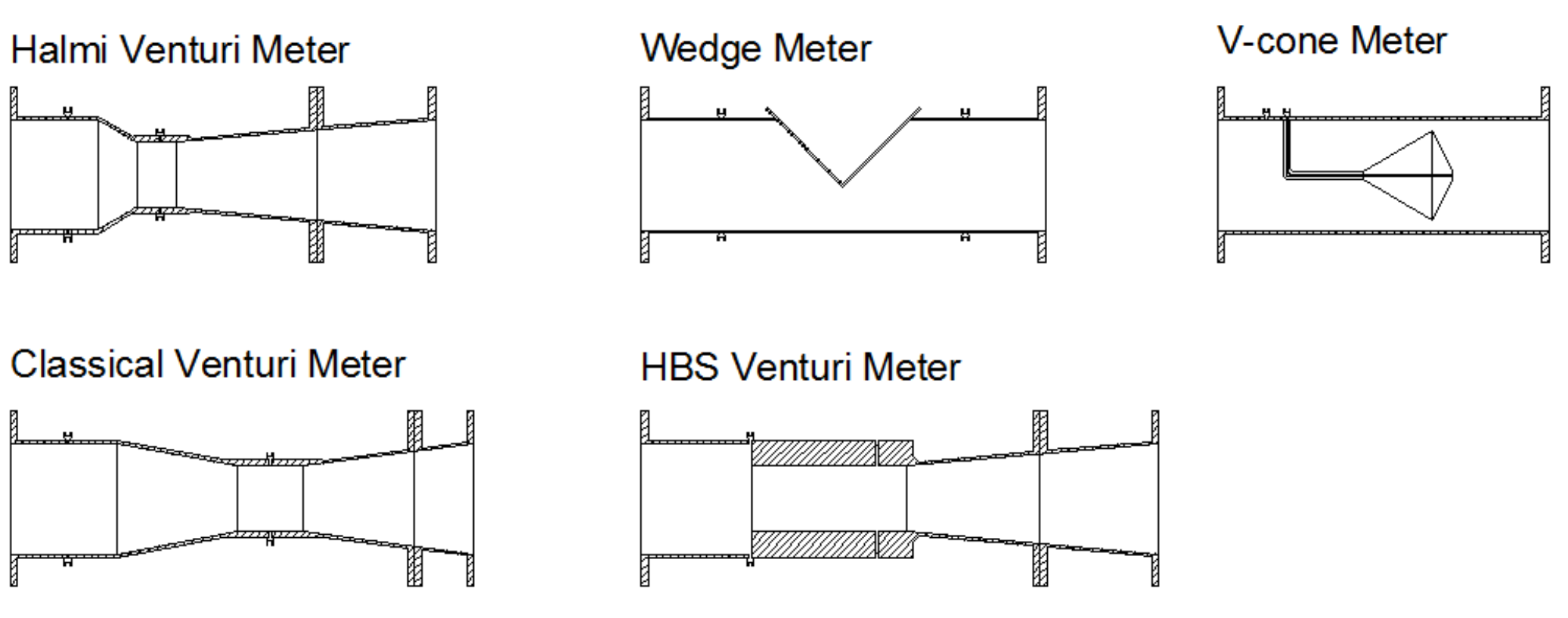
Differential flow meters include three venturis (Classic, Halmi and HBX), a wedge flow meter from Primary flow Signal Inc. and a V-cone from McCrometer. In all differential pressure flow meters, there is a constriction area that creates a pressure differential. These flow meters use the pressure difference between high- and low-pressure faucets to infer the flow rate based on Bernoulli's theorem and the principle of conservation of mass. Classic and Halmi venturi flow meters are achieved by reducing the diameter of the tapered tube. The diameter of the HBX Venturi Flow Meter can be changed instantly. A wedge flow meter constriction is a wedge-shaped object placed in the flow meter. A V-cone has a cone placed in the flow area, forcing water to flow around it. All this contraction causes a pressure difference, so flow can be inferred using a pressure sensor.
See Figure 1 for drawings of all differential tables.
All differential gauges used in this study had similar beta ratios (β), which is the ratio of the diameter at the constriction to the diameter of the pipe. The beta ratio is discussed in further detail
Differential flow meters require a coefficient to infer the correct flow rate, the flow coefficient (Cd).
Cd is the ratio of actual flow to theoretical flow.
At high Reynolds numbers (Re), meters generally have predictable Cd, but at low Re, Cd is not well documented.
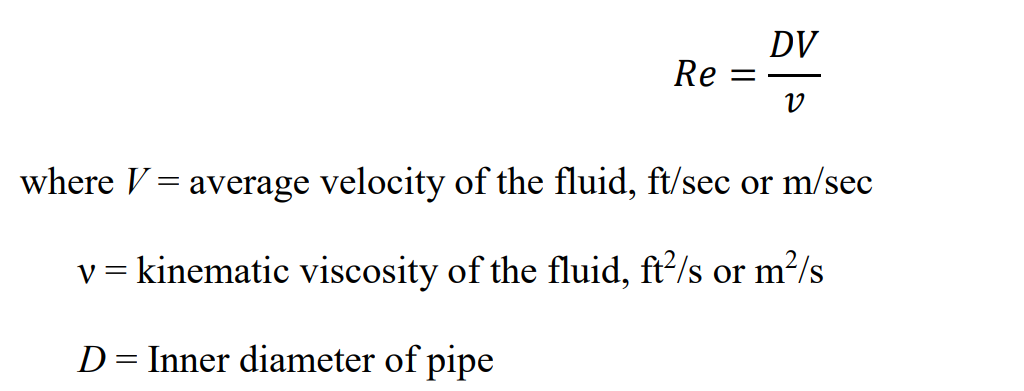
Re is the ratio of inertial force to viscous force, which decreases as the speed decreases or the viscosity increases. Re is a useful ratio because Re is the same for all fluids and Cd is corresponding. In order to achieve the purpose of low Re, this study reduced the speed and calculated the corresponding Cd value. For measuring low flows or leaks, the total range of Cd must be known. Processes such as oil require low repeatability of measurements, so it is important to understand how the instrument will perform within the range of installation conditions.
Flow through a differential production flow meter creates a differential pressure to infer the flow rate. To make that difference, head loss will occur. When selecting a meter, it is important to know the head loss associated with it. Every meter is different and testing is required to know the precise losses. If pumps need to be overcome, losses will increase costs
The suitability of an instrument depends not only on the metering performance but also on the instrument's service life and associated costs and maintenance expenses. Each type of meter has a different lifespan and cost. Different meters are available depending on the buyer's needs. The meters under study will determine service life and associated costs. The main purposes of this article are as follows:
1) Conduct laboratory experiments to find Cd in the range of low Reynolds number to high Reynolds number of the flow meter.
2) Perform laboratory experiments to find the head loss of the flow meter.
3) Research life of flow meter.
4) Electric meter research costs and related operating costs.
This article will be introduced through a literature review of previous research, ongoing research, and current practice on this topic. The results of the current study will be examined, followed by a discussion of the results. The paper will then draw conclusions and conduct necessary further research.
For differential pressure flow meter, few physical studies have been conducted at low Re. This is due to the difficulty in measuring such low flows. However, a number of computational fluid dynamics (CFD) studies have been performed at low Re and have been shown to show good results compared to experimental physics studies. PFS reports that the wedge meter has a coefficient accuracy of +/- 0.50% and a repeatability of +/- 0.20%. Coefficient accuracy is +/- 0.75% for wedge flow meter <1". The wedge is accurate to lower Re and remains constant over a wide operating range (Primary Flow Signal 2012b). Reply. Yoon, Sung, and Lee studied the relationship between Cd and Re for a 90-degree tilt angle change. The experimental range was extended from 12,000 to over 380,000. They found that the calibrated Cd was different at each wedge size, but was about +/- 0.50% over the entire range of Re, with a repeatability of +/- 0.50% per data point (Yoon et al., 2007). Buhidma and Pal studied two-phase oil-in-water emulsions at low Re with a wedge-shaped flow meter. They found that for calibration purposes, the performance of water was approximately the same as that of two-phase oil-in-water at any concentration, and that the size and shape of the wedge affected Cd. The experiment included 4 different wedges with the same wedge angle of 60 degrees, Z/. The six ratios of D are 0.3 and 0.5, where Z is the height of the wedge and D is the diameter of the inner tube. The other two meters have an angle of 0.3 and 0.5. The results show that the cadmium remains constant over a wide range of Re, approximately 500 < Re < 100,000. The data are repeatable within +/- 5% over the entire range. The D ratio and wedge angle vary slightly, but do not affect the consistency (Buhidma and Pal 1996) performed CFD on two different wedge gauges, with wedge angles of 60 degrees and 90 degrees, with increasing wedge height and changes in the apex H/. The initial ratio of D (in meters) is 0.5, where H is the height above the wedge and D is the diameter of the inner tube. To show the power of CFD, we performed a comparison between the Cd of the experiment and the CFD of approximately 60 degrees. The average Cd of CFD for a 60 degree angle is 0.793 +/-. 0.006. For the 90 degree wedge, CFD yielded an average Cd of 0.908 +/- 0.022. It was found that as the H/D ratio increased, the Cd increased. With this configuration, the optimal Cd range was found to be 3,000 to 218,000. al. 2002). Hollingshead has conducted studies using CFD on wedge flow meter. He found that the Cd constant of the wedge flow meter varied by 1% in the range from Re 500 to 50,000. 0.5% with a repeatability of +/- 0.1% at a 10:1 turndown ratio. The instrument produces a linear Cd of Re ≥ 8,000. These percentages are affected by certain fluids and Re and may require special calibration to obtain these values (McCrometer Inc. 2014). Singh, Seshadri, and Gawhade studied the performance of V-cone flow meter and found that at 1,250 < for a 0.64 beta ratio, Re The average Cd value for <218,000 is 0.7256. The other 0.77 beta ratios range from 1,500
Our experts are ready to helpWherever you are, DOWESTON's experienced engineering team is ready to support your product selection and applications - contact us today!
Tell us about your measurement task and we will help with product selection and technical questions.info@doweston.com
We value your privacy!
We and our partners use cookies and similar technologies to process personal data (such as IP address or browser information) in order to personalize the content and advertising shown to you. This helps us display more relevant content and improve your browsing experience. We also use it to measure results and tune website content. Because we value your privacy, we are asking for your permission to use these technologies. You can change or withdraw your consent at any time by clicking the settings button in the lower-left corner of the page.





 Home