1. Positive displacement flow meter
The volumetric flow meter is equivalent to a container with a standard volume, which continuously measures the flowing medium. The greater the flow, the greater the number of measurements and the higher the frequency of output. The principle of the volumetric flow meter is relatively simple and is suitable for measuring fluids with high viscosity and low Reynolds number. According to the different shapes of the rotary body, the products currently produced are divided into: oval gear flow meter, waist wheel flow meter (Roots flow meter), rotating piston and scraper flow meter suitable for measuring liquid flow; servo volumetric flow meter, membrane type and rotary flow meter suitable for measuring gas flow, etc.
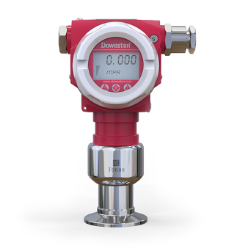
2. Impeller flow meter
The working principle of the impeller flow meter is to place the impeller in the measured fluid and rotate under the impact of the fluid flow. The speed of the impeller rotation reflects the flow rate. Typical impeller flow meter are water meters and turbine flow meter, and their structures can be mechanical transmission output or electrical pulse output. Generally, water meters with mechanical transmission output have low accuracy, with an error of about ±2%, but they have a simple structure and low cost. They have been mass-produced in China and are standardized, universal and serialized. Turbine flow meter with electrical pulse signal output have higher accuracy, with a general error of ±0.2% to 0.5%.
3. Differential pressure flow meter (variable pressure drop flow meter)
The differential pressure flow meter consists of a primary device and a secondary device. The primary device is called a flow measuring element. It is installed in the pipeline of the fluid to be measured and generates a pressure difference proportional to the flow rate (flow rate) for the secondary device to display the flow rate. The secondary device is called a display instrument. It receives the differential pressure signal generated by the measuring element and converts it into the corresponding flow rate for display. The primary device of the differential pressure flow meter is often a throttling device or a dynamic pressure measuring device (pitot tube, velocity averaging tube, etc.). The secondary device is a variety of mechanical, electronic, and combined differential pressure gauges equipped with flow display instruments. Most of the differential pressure sensitive components of the differential pressure gauge are elastic components. Since differential pressure and flow rate have a square root relationship, flow display instruments are equipped with square root devices to linearize the flow scale. Most instruments are also equipped with a flow accumulation device to display the accumulated flow rate for economical accounting. This method of measuring flow using differential pressure has a long history and is relatively mature. It is generally used in important occasions in countries around the world, accounting for about 70% of various flow measurement methods. This meter is used for flow measurement of main steam, feed water, condensate water, etc. in power plants. The products currently produced are: orifice flow meter, wedge flow meter, venturi flow meter, average pitot tube
4. Variable area flow meter (equal pressure drop flow meter)
The float placed in a tapered flow channel with a large upper part and a small small one moves due to the force of the fluid flowing from bottom to top. When this force is balanced by the "revealed weight" of the float (the weight of the float itself minus the buoyancy of the fluid on which it is acting), the trap is at rest. The height of the float at rest can be used as a measure of the flow rate. Since the flow cross-sectional area of the flow meter varies with the height of the float, and the pressure difference between the upper and lower parts of the float is equal when the float is stable, this type of flow meter is called a variable area flow meter or a constant pressure drop flow meter. The typical instrument of this type of flow meter is a rotor (float) flow meter.
5. Momentum flow meter
A flow meter that uses the momentum of the measured fluid to reflect the flow rate is called a momentum flow meter. Since the momentum P of the flowing fluid is proportional to the density of the fluid and the square of the flow velocity v, that is, p v2, when the flow cross-section is determined, v is proportional to the volumetric flow rate Q, so p Q2. Suppose the proportional coefficient is A, then Q=A. Therefore, measuring P can reflect the flow rate Q. Most of this type of flow meter uses detection components to convert momentum into pressure, displacement or force, etc., and then measures the flow rate. Typical instruments of this type of flow meter are target type and rotating wing flow meters.
6. Impulse flow meter
A flow meter that uses the impulse theorem to measure flow is called an impulse flow meter. It is mostly used to measure the flow of granular solid media. It is also used to measure the flow of mud, crystalline liquids, abrasives, etc. Flow measurement ranges from a few kilograms to nearly 10,000 tons per hour. A typical instrument is a horizontal component impulse flow meter. Its measurement principle is that when the measured medium falls freely from a certain height h to a detection plate with an inclination angle, an impulse is generated. The horizontal component of the impulse is proportional to the mass flow rate. Therefore, measuring this horizontal component force can reflect the mass flow rate. According to the detection method of signal (9), this type of flow meter is divided into displacement detection type and direct force measurement type.
7. electromagnetic flow meter
The electromagnetic flow meter is made by applying the principle that the movement of a conductor in a magnetic field generates an induced electromotive force, and the induced electromotive force is proportional to the flow rate. It measures the electromotive force to reflect the pipeline flow rate. Its measurement accuracy and sensitivity are both high. It is often used in industry to measure the flow of water, slurry and other media. The maximum pipe diameter that can be measured is up to 2m, and the pressure loss is extremely small. However, media with low conductivity, such as gas, steam, etc., cannot be used.
The cost of electromagnetic flow meter is relatively high, and their signals are susceptible to interference from external magnetic fields, which affects their wide application in industrial pipe flow measurement. For this reason, products are constantly being improved and updated, and are developing toward microcomputerization.
8. ultrasonic flow meter
Ultrasonic flow meter is designed based on the principle that the speed of ultrasonic waves propagating in the flowing medium is equal to the geometric sum of the average flow speed of the measured medium and the speed of the sound wave itself. It also reflects the flow rate by measuring the flow rate. Although the ultrasonic flow meter only appeared in the 1970s, it is very popular because it can be made into a non-contact type and can be linked with an ultrasonic water level meter to measure opening flow without causing disturbance or resistance to the fluid. It is a promising flow meter.
Classification of ultrasonic flow meter: 1 Doppler ultrasonic flow meter: Transducer 1 emits an ultrasonic signal with frequency f1. After passing through suspended particles or bubbles in the liquid in the pipe, the frequency shifts and is reflected to transducer 2 at the frequency of f2. This is the Doppler limit. The difference between f2 and f1 is the Doppler frequency difference fd. Assume the fluid flow velocity is v, the ultrasonic sound speed is c, and the Doppler frequency shift fd is proportional to the fluid flow velocity v. When the pipeline conditions, transducer installation position, emission frequency, and sound speed are determined, c, f1, and θ are constants. The fluid flow rate is proportional to the Doppler frequency shift. The fluid flow rate can be obtained by measuring the frequency shift, and then the fluid flow rate can be obtained. 2. Time-lag ultrasonic flow meter: Time-lag ultrasonic flow meter uses the principle that the time difference between sound waves propagating downstream and countercurrent in the fluid is proportional to the fluid flow rate to measure fluid flow.
9. Fluid oscillating flow meter
The fluid oscillating flow meter is designed based on the principle that fluid will oscillate when flowing under specific flow channel conditions, and the frequency of oscillation is proportional to the flow rate. When the flow cross-section is constant, the flow rate is proportional to the volumetric flow rate. Therefore, the flow rate can be measured by measuring the oscillation frequency. This flow meter was developed and developed in the 1970s. Since it has the advantages of no rotating parts and pulse digital output, it has great development prospects. Typical products currently include Vortex flow meter and precession Vortex flow meter.
10. mass flow meter
Since the volume of fluid is affected by parameters such as temperature and pressure, the parameters of the medium need to be given when using volume flow to express the flow rate. When the medium parameters are constantly changing, it is often difficult to meet this requirement, resulting in distortion of the instrument display value. Therefore, mass flow meters have been widely used and valued. There are two types of mass flow meter: direct type and indirect type. Direct mass flow meters use principles directly related to mass flow to measure. Currently, commonly used mass flow meters include calorimetric, angular momentum, vibrating gyro, Magnus effect and Coriolis force type mass flow meters. Indirect mass flow meters use a density meter to directly multiply the volumetric flow rate to obtain the mass flow rate.
There are also various weir flow meter and trough flow meter suitable for open channel flow measurement; insertion flow meter suitable for large-diameter flow measurement; laminar flow meters for measuring laminar flow; correlation method flow meter suitable for two-phase flow measurement; as well as laser method, nuclear magnetic resonance flow meter and various tracer methods, dilution method flow measurement, etc.





 Home


