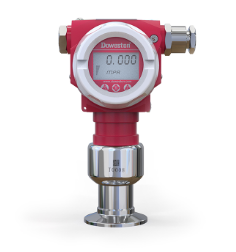
The liquid level difference meter is a digital liquid level meter controlled by a microprocessor. According to the different media through which sound waves propagate, ultrasonic level meters can be divided into three types: solid-medium type, liquid-medium type and gas-medium type. Two ultrasonic transducer probes can be used, or one can be used. In the former, one probe emits ultrasonic waves and another probe is used to receive them; in the latter, one probe is used to transmit and receive ultrasonic waves, but the transmitting and receiving times are staggered from each other.

The ultrasonic transducer used in the liquid level difference meter is composed of piezoelectric crystals such as lead zirconate titanate (PZT) and barium titanate (BaTiO3). Piezoelectric crystals have a piezoelectric effect. When an external force acts on the end face of the crystal, charges will be generated at both ends of the crystal, and the polarity of the two ends is opposite. If the external force is alternating, an alternating electric field will be generated at both ends of the crystal. This phenomenon is called the positive piezoelectric effect.
On the contrary, when an alternating voltage is applied to the electrodes at both ends of the crystal, a mechanical vibration with the same frequency as the applied alternating voltage will be generated along the thickness direction of the crystal, and sound waves will be emitted to the surrounding medium. This is called the reverse piezoelectric effect. The liquid level difference meter can be designed as a transmitting transducer and a receiving transducer based on the reverse piezoelectric effect and the forward piezoelectric effect.

Tell us about your measurement task and we will help with product selection and technical questions.info@doweston.com