Ultrasonic liquid level meter has the characteristics of safety, cleanliness, precision, long life, stability and reliability, easy installation and maintenance, etc. It is suitable for various fields such as acid, alkali, salt, anti-corrosion, high temperature and so on. It can be connected to display tables or various DCS systems through 4~20mA to provide real-time liquid level data for industrial automation operations.
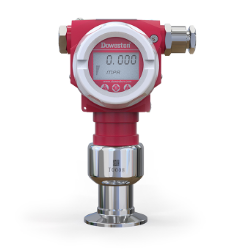
The principle of the ultrasonic liquid level meter is to measure the time required for the entire process of an ultrasonic pulse from being sent to returning. The ultrasonic liquid level meter is installed vertically on the surface of the liquid. It emits an ultrasonic pulse to the liquid surface. After a period of time, the sensor of the ultrasonic liquid level meter receives the signal reflected from the liquid surface. The signal is selected and processed by the transmitter circuit. According to the time difference between the ultrasonic liquid level meter sending and receiving ultrasonic waves, the distance from the liquid level to the sensor is calculated. Ultrasonic liquid level instruments are widely used for liquid level and volume measurement in tanks, pools, and reservoirs, and can also be used for flow measurement in open channels.
So what are the characteristics of ultrasonic liquid level meter?
1. The circuit design uses high-quality power modules starting from the power supply part, and the components are imported with high stability and reliability, which can completely replace the same type of foreign imported instruments.
2. The latest sonic intelligent technology software can perform intelligent echo analysis without any debugging or other special steps. This technology has the functions of dynamic thinking and dynamic analysis.
3. High precision, the liquid level precision reaches 0.25%, and can resist various interference waves.
4. It is a non-contact instrument that does not come into direct contact with liquid, so the failure rate is low. The instrument provides a variety of installation methods, and users can fully calibrate the instrument through this manual.
5. All input and output lines of the instrument are protected against lightning and short circuit.





 Home


