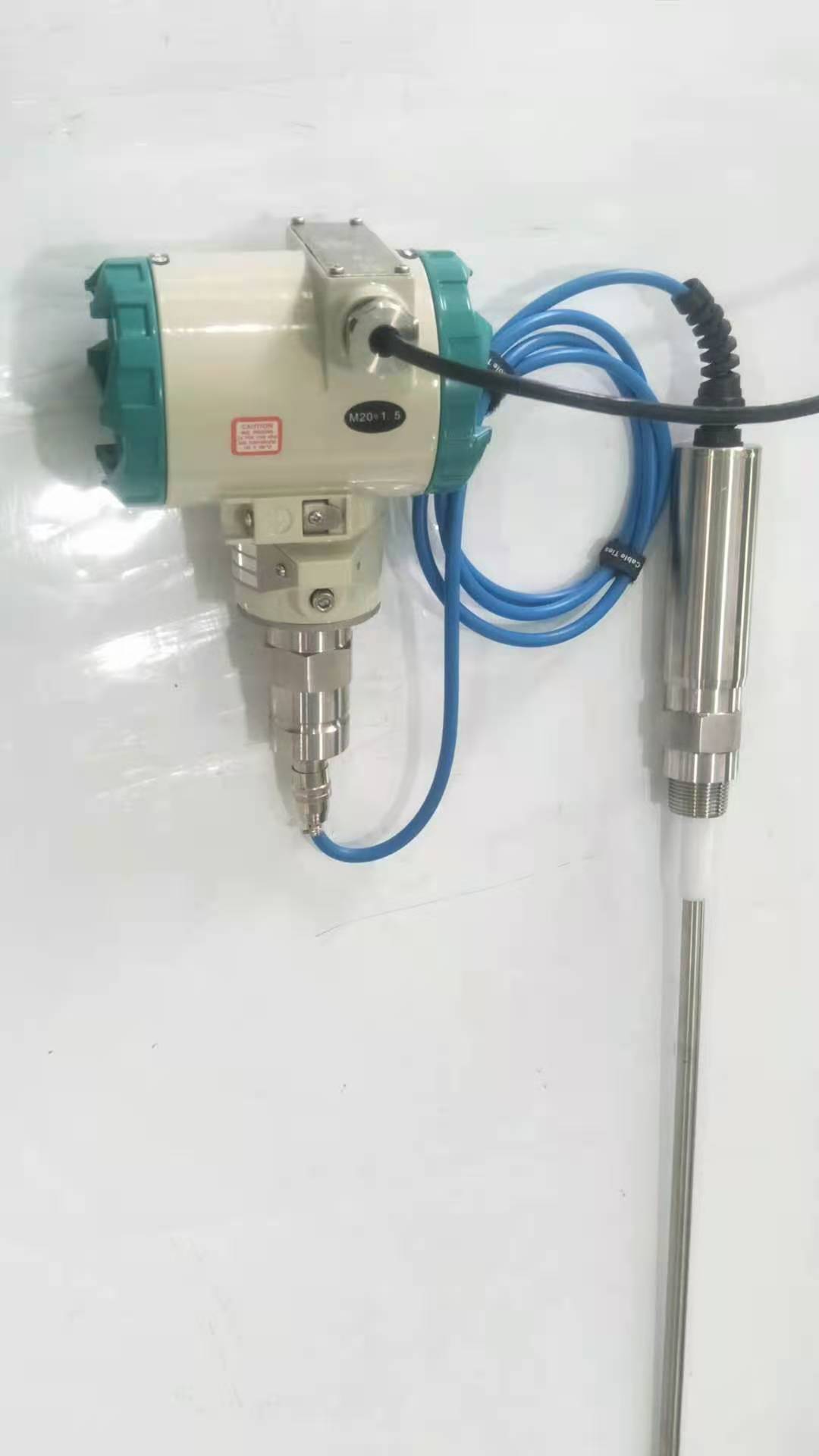
Capacitive level gauges measure the capacitance of a conductive rod inserted vertically into a process vessel. As the process level increases, the capacitance between the rod and the vessel wall increases, resulting in a larger signal output from the instrument.
The capacitance value shown between a metal rod inserted in a container and the metal wall of that container changes only with changes in the dielectric constant (), area (), or distance (). Since is constant (the inner surface of the container is fixed and so is the area of the rod once installed), only or will affect the capacitance of the probe.
There are two basic types of capacitive level probes:
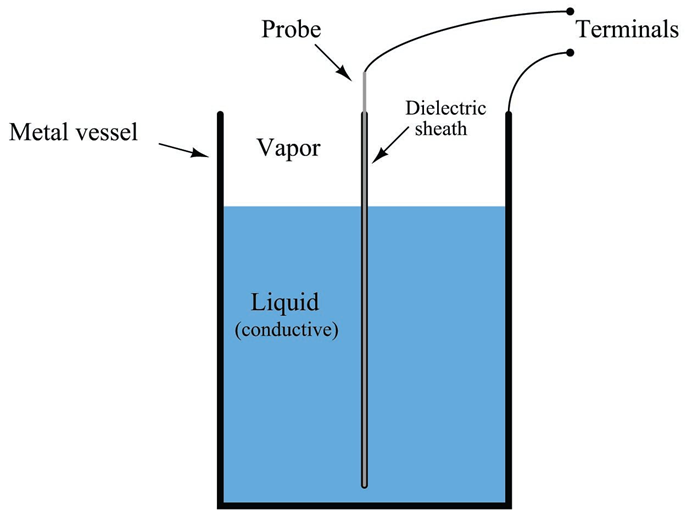
One for conductive liquids and one for non-conductive liquids. If the liquid in the container is conductive, it cannot be used as the dielectric (insulation) of the capacitor.
Therefore, specially designed for conductive liquidscapacitive level probeCoated with plastic or some other dielectric substance, so the metal probe forms one plate of the capacitor and the conductive fluid forms the other plate:
In this kind ofcapacitive levelIn the probe, the variables are dielectric constant ( ) and distance ( ), since the rising liquid level displaces the low-dielectric constant gas and essentially acts to bring the vessel wall electrically closer to the probe. This means that the total capacitance will be greatest when the container is full ( is the maximum effective distance of at least ), and at least when the container is empty ( the gas of is effective and farther away).
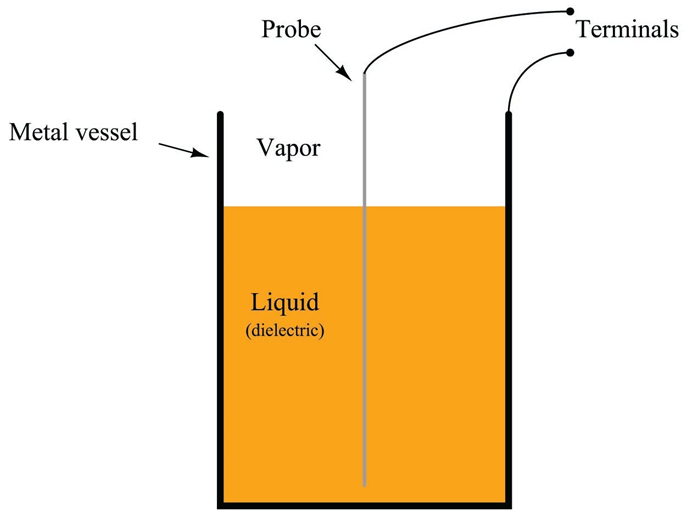
If the liquid is non-conductive, it can be used as the dielectric itself, with the metal walls of the storage container forming a second capacitor plate. Probes are just bare metal cables or rods:
In this type of capacitive liquid level probe, the only variable that affects the probe capacitance is the dielectric constant ( ), provided that the dielectric constant of the liquid is much greater than the vapor space above the liquid. This means that the total capacitance will be greatest (the average permittivity is greatest) when the container is full, and at least when the container is empty. The distance () is constant for non-conductive process fluids, i.e. the radius of the container (assuming the probe is mounted in the centre).
In the non-conductive form of the capacitive-level probe, the dielectric constant of the process material is a critical variable, so good accuracy can only be obtained with this instrument if the process material's dielectric constant is accurately known. When the dielectric constant of a material becomes unstable over time, a clever way to ensure a high level of measurement accuracy is to have a special compensation probe (sometimes called a composition probe) below the LRV point of the instrument, which is always submerged. Since this compensation probe is always immersed in water and always has the same conditions and dimensions, its capacitance is purely a function of the material's dielectric constant (). This provides the instrument with a means of continuously measuring the dielectric constant of the material, which can then be used to calculate the level of that material in the vessel based on the capacitance of the main probe. Includes a compensation probe to measure and compensate for changes in dielectric constant, similar to the inclusion of a third pressure transmitter in the Hydrostatic Tank Expert system to continuously measure and compensate for density. This is a way to correct remaining system variable changes that are not related to level changes.
Capacitive level meters can be used to measure the level of solids (powders and granules) other than liquids. In these applications, the material in question is almost always non-conductive, so the dielectric constant of the substance becomes a factor in the accuracy of the measurement. This can be problematic because changes in moisture content in the solid can greatly affect the dielectric constant, as can changes in particle size. Compensating probes may also not be very useful because their location (at the bottom of the vessel) may not expose them to the same degree of material particle size and moisture content that the main probes experience.
Capacitive meters are typically used in applications where accuracy is not important. These instruments are susceptible to errors caused by changes in the dielectric constant of the process substance, changes in the process vapor space dielectric constant, and stray capacitance in the probe cable.
Capacitive level sensors operate from two electrodes forming a capacitor, usually in the form of two parallel metal plates separated by an insulating (non-conductive or "dielectric") material.
In the most basic sense, a capacitor stores electrostatic energy in an electric field. The capacitor's ability to store this energy (a measurement called "capacitance") increases as voltage is applied to the circuit and as the volume of the insulating material increases.
When used as a liquid level sensor, a capacitor works by processing the capacitance with reference to the dielectric constant of the material being measured and the voltage used to complete the circuit. These measurements are used to determine the tank level. Higher levels of dielectric material result in greater capacitance, meaning the former can easily be measured by the latter.
After applying radio frequency to the capacitor circuit, this method of level measurement is sometimes called RF level sensing.
For example, let's say we are measuring a high capacitance solution stored in a large metal tank. The two electrodes that form the capacitor will take the form of a conductive probe (such as a metal plate) and the container wall itself. The RF signal is activated, causing a low current to flow through the solution. This current changes depending on the amount of solution in the tank – a capacitive switch detects this difference and converts it into an output suitable for the specific application.
In addition to the wide range of materials and applications that can be used, capacitive level sensors offer the following advantages:
Mechanically simple,
There are no moving parts,
Minimal maintenance required.
In addition, they are well suited for point and continuous level measurement and are resistant to agitation.
Our experts are ready to helpWherever you are, DOWESTON's experienced engineering team is ready to support your product selection and applications - contact us today!
Tell us about your measurement task and we will help with product selection and technical questions.info@doweston.com
We value your privacy!
We and our partners use cookies and similar technologies to process personal data (such as IP address or browser information) in order to personalize the content and advertising shown to you. This helps us display more relevant content and improve your browsing experience. We also use it to measure results and tune website content. Because we value your privacy, we are asking for your permission to use these technologies. You can change or withdraw your consent at any time by clicking the settings button in the lower-left corner of the page.





 Home