A gas flare is a safety device that burns excess gas and waste gas; Sage Metrology solves many of the flare gas measurement challenges.
Gas flares are safety devices used in many factories to burn waste or excess flammable gases. Flares are most commonly used in the oil and gas industry, including refineries and natural gas production and processing. However, flaring may also occur in other industries, such as wastewater treatment plants, biogas and landfill sites. It is often necessary to measure flare gas flow for environmental reporting or to obtain a material balance for an operation.
Flare gas measurement challenges
There are several challenges to flare gas measurement that must be considered with any flare gas meter. While some of these difficulties are industry-specific, DOWESTON's FTW-1600 Series Gas Mass Flow Meter solves the following problems:
Traffic changes. During normal operation of the flare system, the gas flow rate is very low, while during blowouts or other abnormal operating conditions, the flow rate may increase significantly. The Sage thermal mass flow meter provides the sensitivity to measure low flow rates during normal operation, and due to its high turndown ratio, it can measure high flow rates during abnormal conditions.
Mixed gases. Typically, the gas flow to the flare will consist of a mixture of different gases. Flares from refineries and other process operations often contain a mixture of hydrocarbons and sometimes hydrogen. The composition will depend on the source of gas entering the torch. Biogas, biogas and landfill gas are methane (CH4) and carbon dioxide (CO2) along with small amounts of other inert gases. Natural gas is typically 90%+ methane, ethane and small amounts of other hydrocarbons. Inert gases such as nitrogen (N2) and carbon dioxide (CO2) may also be present. DOWESTON's FTW-1600 Series Gas Mass Flow Meters calibrate thermal flow meters using a specified actual gas mixture to provide the highest possible accuracy, whereas other manufacturers may perform "air equivalent" calibrations.
Change gas composition. Changing gas composition will affect the heat transfer ability of the gas and affect the performance of the flow meter. DOWESTON's FTW-1600 Series Gas Mass Flow Meter can simulate how changing gas mixtures affect performance. Small changes in composition (such as changes in the methane/carbon dioxide percentage in biogas) will produce small changes in performance that are within the accuracy requirements of the application. However, some applications, such as main flare headers in refineries, gas plants or chemical plants, may experience significant changes in gas composition. DOWESTON's FTW-1600 Series Gas Mass Flow Meters will review changes in gas composition and the use of thermal flow meters is not recommended in any application where significant changes in gas composition may occur.
Torch gas meter
The use of thermal mass flow meters in flare gas service must be thoroughly evaluated. Thermal flow meters should be avoided in flare applications for main flare heads in refineries and other process operations. Whereas DOWESTON's FTW-1600 Series Gas Mass Flow Meter has proven successful in flare applications for biogas, biogas, landfill gas and natural gas
What are the differences between different flow meters? How to choose a flow meter that suits you?
DOWESTON's FTW-1600 series gas mass flow meters measure gas flow based on the concept of convective heat transfer.
As gas flows through the heated flow sensor, the gas molecules carry away the heat and the sensor cools and loses energy.
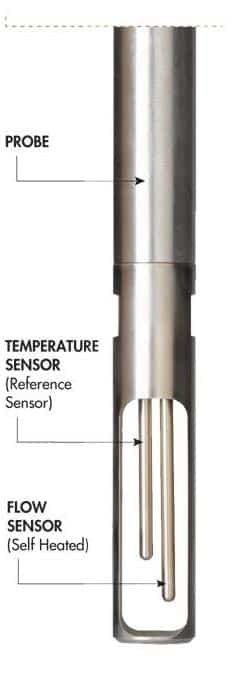
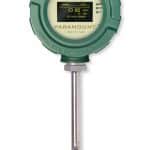
TheSage flow meterIs available in anyOnline traffic agencyorinsertion type. In either case, the meter's probe is inserted into the airflow of a duct, chimney, or duct. There are two sensors at the tip of the instrument probe. These sensors are resistance temperature detectors (RTDs) or resistance thermometers, which measure temperature. The RTD consists of durable reference grade platinum windings encased in a protective 316 SS or Hastelloy C sheath.
One of the RTDs is heated by an integrated circuit and serves asflow sensor, while the other RTD is used asReference sensorAnd determine the gas temperature. Sage proprietary circuitry maintains continuous overheating between the flow sensor and reference sensor. As gas flows through a heated RTD, the flowing gas molecules transport heat away from it. As a result, the sensor cools and energy is lost. The circuit balance is disrupted and the temperature difference (ΔT) between the heated RTD and the reference RTD changes. Within one second, the circuit recovers the lost energy by heating the flow sensor to regulate the superheat temperature.The electrical power required to maintain this superheat represents the mass flow signal.
What are the advantages of thermal mass flow meters?
Thermal flow meters have no moving parts, reducing maintenance and allowing use in demanding applications including saturated gases.
Gas mass meter calculationmass flowInstead ofVolumetric flow. They require no temperature or pressure correction, which means there is no additional cost to purchase and install additional equipment.
Thermal flow meters provide excellent accuracy and repeatability over a wide range of flow rates.Thermal flow meters can measure flow in large pipes.
FAQ
What are the advantages of DOWESTON's FTW-1600 series online flow meter and insertion flow meter?
There are two main thermal mass flow meter configurations, inline and insertion. Both are often referred to as integrating meters.
What types of flow meters are there?
The types of gas meters used for flow measurement are divided into mass flow meters, velocity flow meters, differential pressure flow meters and positive displacement flow meters.
Mass flow vs. volume flow?
When comparing mass flow rate to volumetric flow rate, there are some clear advantages to using a thermal flow meter over a volumetric flow meter.
What is the measured mass flow rate?
Understand the relationship between gas mass flow measurement units and various instrument types, and understand the difference between volume flow and mass flow.
DOWESTON is a company that provides a full range of flow meters. It is wholly owned by the DOWESTON Group located in Missouri, USA.
Select the service you need:
Selection guide
Quotation (5% online discount)
Detailed product documentation and more
Product Selection
Expert Answers
5% off for new customers
What is the price of DOWESTON flow meter?Inquire and win a prize
Our experts are ready to helpWherever you are, DOWESTON's experienced engineering team is ready to support your product selection and applications - contact us today!
Tell us about your measurement task and we will help with product selection and technical questions.info@doweston.com
We value your privacy!
We and our partners use cookies and similar technologies to process personal data (such as IP address or browser information) in order to personalize the content and advertising shown to you. This helps us display more relevant content and improve your browsing experience. We also use it to measure results and tune website content. Because we value your privacy, we are asking for your permission to use these technologies. You can change or withdraw your consent at any time by clicking the settings button in the lower-left corner of the page.





 Home