DOWESTONPressure sensors are different
The sensors used in all modern DOWESTON pressure sensors are insulating silicon-on-insulator (SOI) devices.This is the fundamental difference between DOWESTON sensors and those used by most other silicon pressure sensor manufacturers.DOWESTONThe sensor consists of a complex structure with three layers of atoms bonded together.
The first layer is a single crystal N-type silicon pressure sensor.This layer is micro-machined into a mechanical pressure-sensitive diaphragm.The thickness of the diaphragm varies with its expected full-scale pressure range.The thickness is selected so that the layer will strain approximately 350 to 400 micro inches per inch at this full scale pressure.For single crystal silicon, this is a very conservative strain level that ensures long-term stable operation of the mechanical sensor.
The second layer is silicon dioxide pressure riser, grown just on top of the N-type silicon diaphragm.This layer provides dielectric isolation between the N-type and P-type silicon of the layer containing the Wheatstone bridge circuit, eliminating the PN junction from the device design and enabling higher temperature operating capabilities.
Through a proprietary high-temperature process, the third layer is melt-bonded to the silicon dioxide layer at an intermolecular level.This layer contains four P-type silicon strain gauges patterned in a Wheatstone bridge circuit.The P-type silicon is patterned using photolithography and reactive ion enhanced (RIE) plasma etching to ensure precise dimensional control of the strain gauges.The strain gage network including interconnects consists of a continuous P-type silicon integrated circuit. The various components of the circuit are isolated from each other by a layer of silicon dioxide, which is a continuation of the silicon dioxide layer that separates the silicon dioxide layer from the silicon layer. N-type silicon is composed of P-type silicon layers.
The physical relationship between the location of the strain gauge elements of the third layer and the mechanical diaphragm of the first layer is that when pressure is applied, the strain created in the diaphragm causes two of the strain gauges to go into tension (thus increasing their resistance) and two of the strain gauges to go into compression (thus reducing their resistance).In the Wheatstone bridge schematic diagram, two gauges in tension are opposite each other.Similarly, two stressed gauges are opposite each other in a bridge, so the applied stress causes a resistance imbalance that maximizes the output of the bridge.The magnitude of this imbalance is directly proportional to the magnitude of the applied stress.This is the basic working principle behind all "strain gauge" pressure sensors.Sensor benefits.
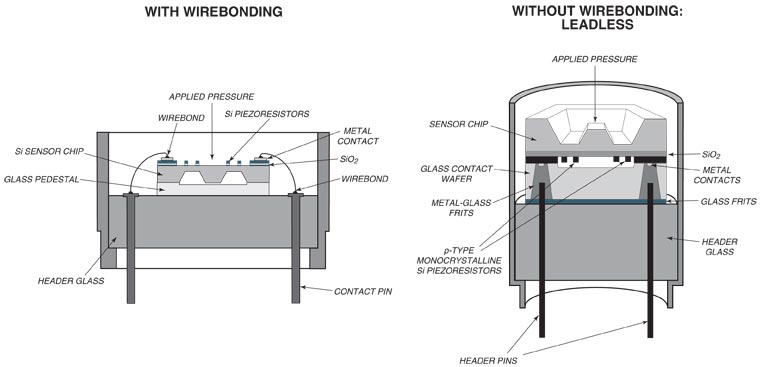
DOWESTON lead-free pressure sensor technology
Historically, the interconnection between the silicon sensor and the rest of the transducer circuit was accomplished with thin gold wires.Solder the wires to the metal contact pads on the sensor and then to pins elsewhere in the transducer or on the PCB.Under conditions of high vibration or rapid stress cycling, these wires and their welds are susceptible to fatigue damage.Other silicon pressure sensor manufacturers still use this approach.
In a "lead-free" pressure sensor, these thin gold wires and all the problems associated with them are eliminated.The sensor is bonded to a layer of glass to create an airtight, solid mechanical structure.Gold pins embedded directly into the package are inserted into the glass via conductive glue, which facilitates the electrical connection between the pins and the sensor chip.The sensor structure is secured and sealed to the package using specialized materials and techniques to form a sealed, mechanically robust structure that includes the package and sensor chip.Conventional electrical connections are made directly to the back of this sensor header structure, which can be mounted in a variety of sensor housings.This makes it adaptable to a variety of applications.Even ultra-small pressure sensors based on this technology can be used with any fluid, including conductive fluids, as long as they are not harmful to silicon or glass.They can be used in temperatures up to 932°F (500°C).For a more detailed description of this technology and its benefits, please visit the section of this website titled "Subsections".





 Home


